Define success however you want. Achieving success is a goal that nearly everyone is striving for, whether it’s reaching a specific career milestone, getting into shape, learning a new skill, or developing a new outlook on life.
We often think of the fastest path to success as the shortest path—the one that requires the least effort and the least amount of time.
Is the fastest path the shortest?
But what if the fastest path to success isn’t the shortest path? This concept can be seen in Adam Savage’s (MythBusters) experiment, where a ball takes the same amount of time to travel a curved path as it does a straight path.
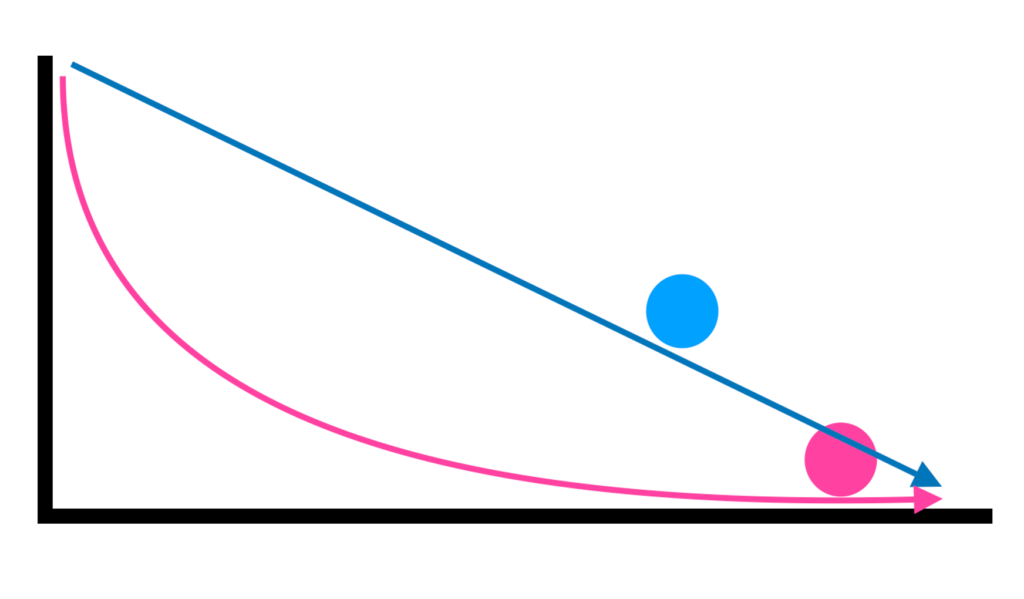
While this example with the two balls traveling down may be an oversimplification of the complexities of achieving success, it demonstrates an important point: sometimes the fastest way to success is not the most direct path. This concept can be applied to building momentum around habits.
“I have surrendered my free will to the years of accumulated habits.”
“If I must be a slave to habit let me be a slave to good habits.”
Og Mandino, The Greatest Salesman on Earth.
Are you chunking your habits?
Habits are a major part of our lives and can help us achieve our goals, but forming them can be difficult and time-consuming. That’s why it’s important to use the right strategy when forming them. According to Charles Duhigg, author of The Power of Habit, one of the best ways to establish a habit is to attach it to an existing habit.
Eventually our brains chunk habits. By chunking your brain takes multiple steps, like checking your mirrors, signaling, slowing down, and turning the wheel into a single action of making a turn while driving.
One might also consider taking a larger habit or outcome and breaking it into smaller parts that your brain will eventually chunk. By chunking a habit, we can build up to where we want to be and create momentum that will help us stick with the new habit in the long run. Rather than trying to form a habit all at once, chunking it breaks it down into more manageable pieces. This makes it easier to approach, and allows us to focus on one piece at a time. Forming a habit this way can give us a sense of accomplishment as we complete each piece, and helps to build toward changing or adding habits. By focusing on small, achievable goals, we can gradually move closer to our larger goal.
Build momentum around existing routines
It’s important to note that building momentum around our habits doesn’t mean that we have to completely abandon our normal routine. Instead, we can use our existing habits and routines as a foundation for our new habits. Duhigg explains habits as a simple loop. All habits are basically cue – routine – reward loops. We can leverage our existing routines to create the cues or rewards for the new routine we want to establish.
For example, if our goal is to start exercising, we can use our existing morning routine as a foundation for our new habit. Instead of trying to form a new habit of waking up early to exercise, we can use our existing morning routine as a starting point, and slowly add in new habits like stretching or light jogging.
Ultimately, the path to success isn’t always the shortest or the most direct. Our habits and routines can be powerful tools in helping us reach our goals, but it’s important to remember that sometimes the fastest path to success might not be the shortest. By chunking our habits and using our existing routines as a foundation, we can build momentum around our habits and gradually move closer to our goals.